
What 1000s of Open Enrollment questions reveal about employee benefits confusion



Let AI summarize this content:

.svg)
.svg)
.svg)
.svg)
Table of contents

Share this post

.svg)
Summary
November 14, 2025
Open Enrollment (OE) can be an overwhelming experience for employees and their families. Even with weeks of webinars, FAQs, and reminders from HR, many still start OE unsure about their benefits—what’s offered, what’s changing, and what it means for them. And when employees start OE confused, it often leads to suboptimal plan choices, underutilized benefits, and unnecessary workload for HR down the line.
That’s why it’s been so exciting to see our customers and their employees using Carly, Avante’s AI agent that offers real-time benefits guidance, during this year’s OE. We’ve been able to watch how people use Carly to ask questions, look for guidance, and get clarity on topics that are often confusing or easy to misinterpret. Across thousands of questions this year, we’ve seen firsthand just how much hidden confusion exists beneath the surface during OE.
Benefits terminology is challenging—and alarmingly so. One oft-cited survey by the Kaiser Family Foundation (KFF) asked working-aged adults about basic health insurance terms and found that only 4 % answered all ten items correctly; and nearly 30 % answered 4 or fewer correctly (1). This indicates that many people who need to select or use benefits aren’t confident with the foundation of how plans work, which can translate into big financial consequences.
To understand where employees were getting stuck, we analyzed questions from the most recent 10 days of Open Enrollment across all customers. Because OE dates vary by employer, this window captured activity from early, mid, and late enrollment periods. We used our own AI to flag questions that showed signs of confusion, focusing specifically on conceptual confusion — when someone misunderstands how a benefit works — rather than operational issues like logging in or finding a document. What we found was really interesting. While the majority of questions were straightforward information-gathering (for example: “How many telehealth visits are included in the plan?”), about 5% of all questions exhibited signs of genuine confusion about key benefits concepts.
You might think “5% doesn’t sound too bad”. But it’s a critical component of questions.
Why the 5% matters: the true costs of employee benefits confusion
At first glance, 5% might sound small. Yet it’s an important signal — because these are the moments when someone starts from a reasonable place and ends up slightly off track:
- “Can I have an HSA if my spouse is on a different plan?”
- “Can I use my FSA for premiums?”
- “Why can’t I change my plan mid-year if my doctor moved?”
- “Does parental leave come out of my PTO balance?”
These questions matter because they represent points where misunderstanding meets decision-making—and that’s where the real risk lies.
Those small misunderstandings compound fast — especially in self-funded environments, where small employee decisions directly influence employer medical costs.
1. Hidden confusion
That 5% is just the visible tip of the iceberg. Employees are still building their benefits literacy and may not even know what to ask. For every person who asks a confusing question, there may be several more who remain silent, unsure where to begin.
2. Savvier users are the ones asking
The employees using AI for benefits questions may tend to be the more engaged or proactive ones. If they are experiencing conceptual confusion, it suggests even deeper uncertainty among less-engaged employees—those least likely to seek clarification before making a choice.
3. Confusion leads to costly choices
When people misunderstand the basics, they make decisions that can cost them. For example, research of public-employees found that switching to a financially dominant health plan — yet still often avoided — could save an individual $150 to $1,400 per year. At the same time, other analyses estimate that up to 40% of employer-sponsored benefits value goes unused annually due to lack of awareness or understanding. The cost of confusion adds up — to employees in higher out-of-pocket expenses, and to employers in under-utilised benefits spend.
Where employees get most confused about their benefits
Most confusion clustered around four topics: HSAs, FSAs, medical eligibility, and leave policies.
- HSAs: Employees often asked about who qualifies and how contributions work—treating the HSA like something you “sign up for” rather than a tax vehicle tied to a specific plan type.
FSAs: Questions tended to be about boundaries and interactions—“Can I roll over my balance?” or “Can I have both an FSA and an HSA?”—showing that people grasp the basics but struggle with the fine print.
Medical coverage & eligibility: Many assumed coverage rules followed common sense—“Can my spouse stay on my plan after divorce?” or “Can I switch plans midyear?”—not realizing how strictly policy defines eligibility. - Leave and time off: Employees often mixed up categories like parental leave, disability, and PTO, expecting them to come from one shared pool. The issue wasn’t entitlement—it was structure.
Why confusion matters and what HR leaders can do about it
Because when benefits rules live deep in policy documents or compliance tables, people start to fill in the blanks with intuition — and intuition is often wrong in this space. And when HR can’t see the confusion as it’s happening, they can’t intervene before employees make misinformed decisions that drive costs and dissatisfaction.
With Carly, benefits leaders can know in near–real time which topics generate confusion, how many employees are asking them, and can tailor educational outreach accordingly. Instead of waiting for the annual engagement survey, you can spot “confusion hot-spots” during OE. This level of real-time visibility gives HR a completely new advantage: the ability to close knowledge gaps before they turn into support tickets or costly plan choices.
What’s more, Carly doesn’t just supply a “yes/no” answer—it offers a digestible explanation built for adult learners: snackable, on-demand, at the point of query. No more waiting for the benefits team to respond to the inbox. This shifts the employee experience from “flying blind” to “in-flight clarity”. And because Carly is embedded directly into the systems employees already use—Slack, Teams, HCM, email—there’s no new portal to learn and no change management burden.
Open Enrollment shouldn’t be a guessing game. And the same patterns we see during OE show up all year: during life events, plan changes, and moments when employees need clarity most.
With real-time intelligence and personalized guidance, employers can finally shift from reactive support to proactive benefits leadership — turning clarity into a strategic advantage all year long.
References
- Norton, M., Hamel, L., & Brodie, M. (2014). Assessing Americans’ Familiarity With Health Insurance Terms and Concepts. Kaiser Family Foundation. https://www.kff.org/affordable-care-act/assessing-americans-familiarity-with-health-insurance-terms-and-concepts/
- Brooks, C., & Hamman, M. (2018). Suboptimal Decision Making in Health Plan Choices. University of Wisconsin–Madison, Center for Financial Security.
- SEB Administrative Services Marketing Team. (2024). Breaking Barriers: How to Maximize Employee Benefits Utilization for Real Impact. SEB Administrative Services Inc.https://seb-admin.com/blog/breaking-barriers-how-to-maximize-employee-benefits-utilization-for-real-impact/

Related content


Case Study
How Samsung’s benefits team became AI-native
Challenge
A benefits program running on disconnected data
Samsung Semiconductor’s benefits team was running a multi-million-dollar program, but their data couldn’t tell them whether it was working the way they intended, or help them shape strategy and make the case for change to leadership. Claims, Rx, dental, vision, point solution, and wellness data all arrived directly from vendors, each source on its own, never reconciled, leaving the team no way to reason across them.
The pressure came to a head at renewal. Samsung’s point solution contracts were all up at once, and the performance guarantees underneath them rested on each vendor’s own anticipated ROI, quantified largely from employee attestations rather than objective data. Sarah Schutzberger, Samsung Semiconductor’s Benefits and Wellness Sr. Manager, who is responsible for the entire program, wanted to stop relying on fragmented information and tie every point solution back to actual claims. At the same time, with the team scaling for growth and employees increasingly expecting AI-grade speed, she wanted to modernize the employee experience too.
“Everything before Ava was fragmented. We relied a lot on the data being provided directly to us from our vendors. Now we’re able to connect the dots between each of our benefits to truly understand the employee impact.”

Sarah Schutzberger
Benefits and HR Operations Sr Manager, Samsung
Solution
Two agents, one connected platform
Samsung Semiconductor deployed Avante’s AI-native benefits intelligence platform. It securely brings together claims and eligibility, point solution data, plan documents, and the vendor contracts behind them into the Vault, and two purpose-built AI agents sit on top of that shared foundation. For most benefits teams, those sources never connect. With Avante, they do.
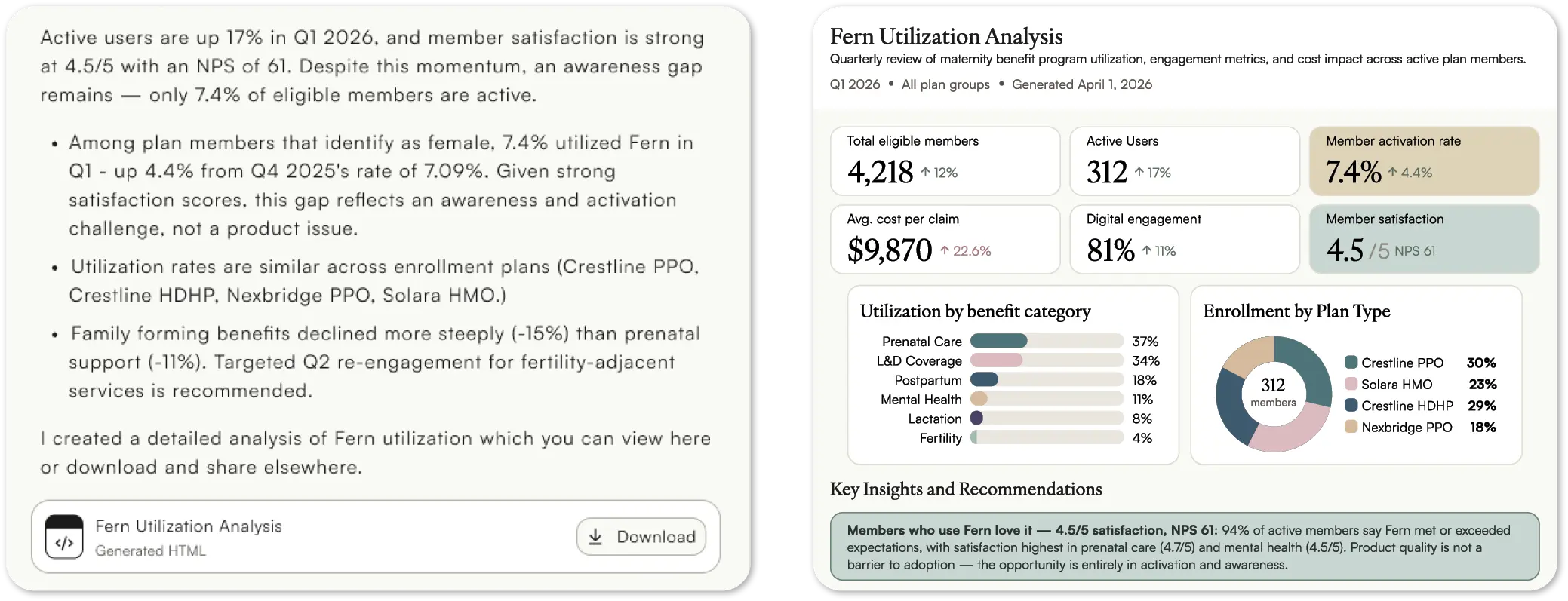
Ava
Ava, the agent for the benefits team, reasons over all of it, reconciling vendor contracts and reports against the actual claims on demand. It can generate reports and build branded presentations. The team can bring its own data too, uploading spreadsheets, PDFs, and files into a conversation. It acts like an expert benefits teammate that knows the company, its programs, and its goals, and delivers objective, near real-time insights when they’re needed. “I was looking for a data warehouse,” said Sarah, “and this is so much better. Instead of static dashboards or sending requests to an analyst, I have real-time insights at my fingertips on any question I have.”
Screens are illustrative. Names and data shown are fictional to protect user privacy.
Carly
Carly, the agent for employees, gives Samsung’s workforce real-time, accurate answers to benefits questions, and prompts the right next step rather than answering only the literal question. It helps employees find and use benefits they did not even know they had, at the exact moments they need them most.
Screens are illustrative. Names and data shown are fictional to protect user privacy.
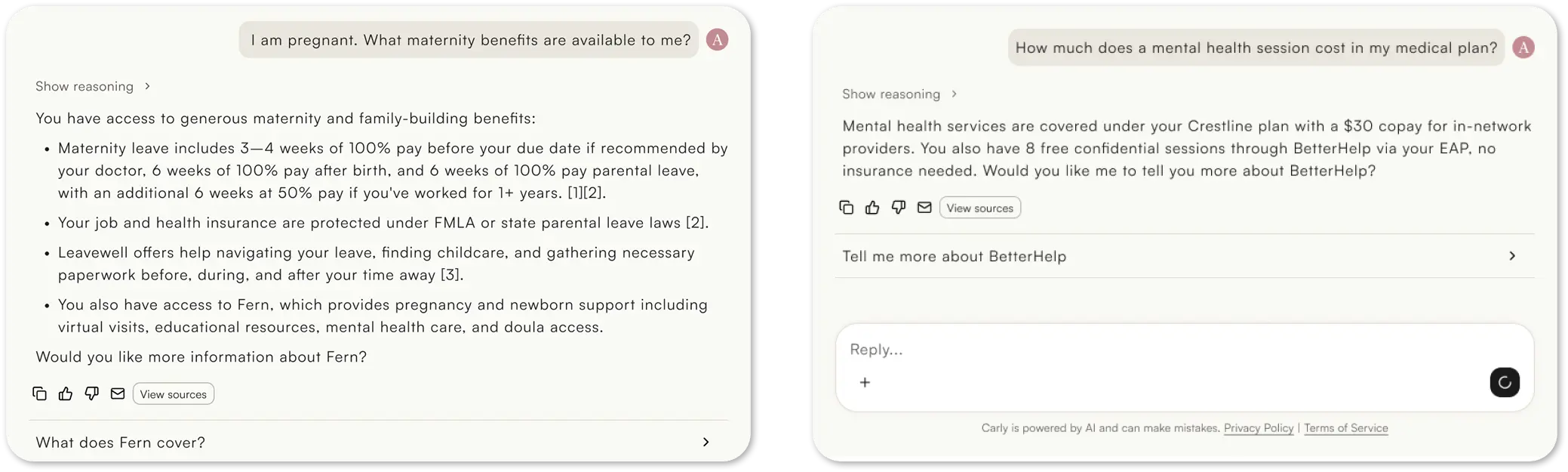
Together, the two agents give the entire company a complete picture of its own benefits, making the use cases below possible for the first time.
Results
What the team does with Ava
The use cases are virtually endless, from building reports to making the case for new programs, from developing customized communications to pressure-testing plan redesign decisions. These are just a few the team acted on in its first three months with Ava.
Use case 1: 66% increase in Lyra utilization
Lyra had traction, with strong engagement and a high share of employees in care relative to its book of business. But when the team dug into behavioral health using Ava, they were able to compare utilization across Lyra and the medical plan, the EAP and the carrier, two datasets that almost never get connected. They surfaced a gap they could not have seen before: a large share of dependents, especially children, were routing through the medical plan for behavioral health instead of starting with Lyra, where the team wants people to begin. The stakes are meaningful: care comes in on day one through Lyra, versus waits of two weeks or more through the medical plan.
The team used Ava to draft communications for that exact parent-and-dependent population, timed to Mental Health Awareness Month, and sent them that week. They also took the finding back to Lyra so it could sharpen its own outreach, and opened a conversation with the medical plan provider about surfacing Lyra first inside the portal. The result: from the first communications in May through the end of June, engagement with the dependent population improved and utilization increased 66%.
“It was a ten-minute chat with Ava that gave us key insights, so we could make targeted communications and address the exact gap instead of throwing spaghetti at the wall and sending out marketing materials that weren’t necessarily hitting.”
Cara Ayala, RD, CPT, CHC
Wellness and Benefits, Associate Manager, Samsung
Use case 2: Making the case for healthier food options
As dietitians, Sarah and Cara had wanted to address nutrition through the company café for years, and the project kept getting pushed aside. Working from the claims data, they pulled the disease states most influenced by nutrition, gave Ava their clinical guidance (whole-foods-first, plant-forward, lean proteins, healthy fats, and a simple green/yellow/red system employees could follow), and used Ava to produce an evidence-based meal program.
The café team now plans to use this framework during the current RFP process to ensure the new vendor is able to execute successfully. Additionally, the team will track the changes in their food program along with medical claims to see the impact. A project that had waited years came together in a single 2-hour planning session.
“Revamping our cafe and food options has been a passion project of ours, but it’s a project that gets pushed to the wayside year after year. But with Ava, it is now possible to move forward.”
Cara Ayala, RD, CPT, CHC
Wellness and Benefits, Associate Manager, Samsung
Use case 3: Building an airtight sabbatical program ROI proposal
Hortencia Alcazar, the Senior Benefits Analyst at Samsung Semiconductor, had built a sabbatical analysis by hand about two years ago. It took two to three weeks of research, formatting, and modeling. She rebuilt it this year with Ava, and it came together in a few hours. Ava pulled in turnover, mental health burnout claims, replacement cost, and tenure assumptions to model ROI at different vesting points, then packaged the work as an executive summary and slides ready for leadership. What stuck with Hortencia and the team was that when they tried to trick it with the data, it held its logic and double-checked them, reasoning exactly as they would have. The proposal is now slated for Samsung’s 2027 program.
“I’d classify Ava as a thought partner and an analyzer.”
Hortencia Alcazar
Senior Benefits Analyst, Samsung
Endless possibilities for AI-native teams
In addition to the use cases above, the team:
- Built a custom manager support guide for mental health crises in minutes by combining Samsung’s own mental health crisis-response document with materials from Lyra
- Assessed whether their preventative care solution was reducing cardiovascular disease and diabetes and found low engagement among comorbid members who need it most, driving targeted communications
- Explored redesigning the medical plan for next year, including options such as a migration from the OAP to an HDHP, which will inform future negotiations
- and more…
Results
What Carly does for employees
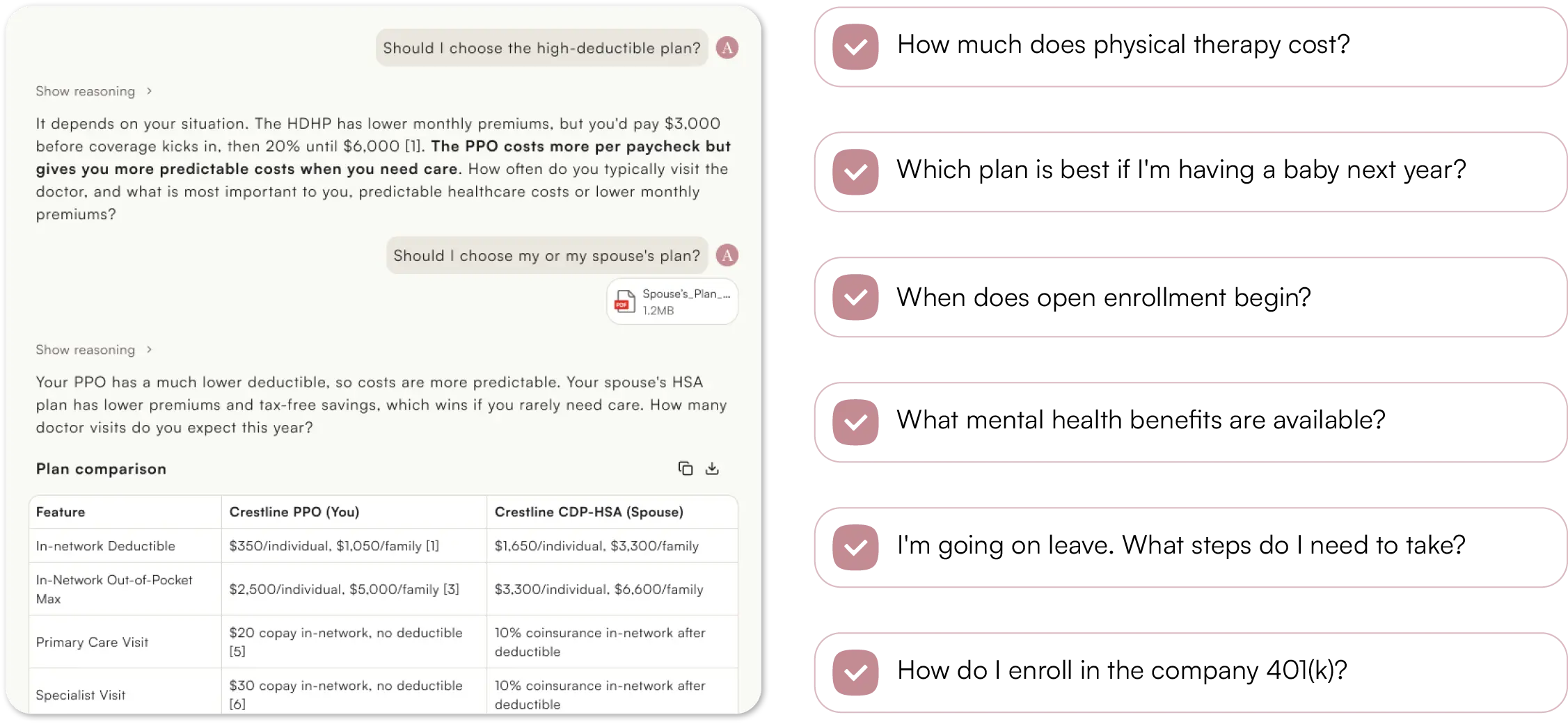
Before Carly, an employee who wrote to the shared service center could wait more than 48 hours for a reply, and often got an answer to only the exact question they had asked. Carly answers in real time, meeting the employee where they are with personalized guidance. 16% of questions come in after hours, when the benefits team isn’t available, meeting an employee at the exact moment they need support.
It also prompts the right next step. For example, when an employee asks about mental health coverage under the medical plan, Carly also points them to Lyra, the path the team wants people to take first. Every employee question becomes a chance to drive awareness of the benefit they should be using, at the moment they need it. In the last four months alone (February – May), Carly instantly and accurately answered over 1,500 employee questions, saving the benefits team approximately 930 hours.
Open enrollment, when question volume is highest, was a key point in the year to prove Carly’s efficacy and impact. According to Sarah Schutzberger, “It was the smoothest open enrollment we’ve ever had. The amount of time it saved our team was extraordinary.”
“Avante is transforming our employees’ experience, is giving our benefits team time back, and has yielded insights resulting in impactful interventions, which are having a positive impact on the health and wellbeing of our team.”
Kevin O’Connell
Senior Director, Total Rewards & HR Operations, Samsung
Screens are illustrative. Names and data shown are fictional to protect user privacy.
How the work itself changed
With Carly fielding the day-to-day employee questions, the team reclaimed the hours it once lost to repetitive inbox support and redirected them to strategy and program development.
The team spends that reclaimed time with Ava, now its first stop for any question, communication, or decision. They use Ava to answer real-time questions in a standing Friday meeting with leadership and bring it to events to pressure-test ideas on the spot.
Ava gives them more strategic insight, faster, and it’s backed by data they trust. In its first few months, the team reclaimed hundreds of hours using Ava to build leadership and employee-facing deliverables and run dozens of cross-source claims analyses that used to take weeks by hand, or days waiting on vendors. That level of visibility and ownership also changes what gets approved. Walking into leadership with the data and the reasoning behind a recommendation moves more initiatives forward, and gives the team the confidence to put program and plan redesign recommendations on the table.
“It’s easier to push things through leadership when you have the data and the why behind the strategy.”
Sarah Schutzberger
Benefits and HR Operations Sr Manager, Samsung
“I don’t know what I did before Ava.”
Cara Ayala, RD, CPT, CHC
Wellness and Benefits, Associate Manager, Samsung
Look ahead
For Samsung, these are the early innings. On the roadmap: bringing their own drug-utilization data to PBM negotiations; connecting LOA, short-term disability, Lyra, and medical claims to forecast and prevent leaves; and next year’s medical plan design.
Benefits clarity for employees and HR
Samsung Semiconductor runs a generous benefits program, including several point solutions, focused on emotional, social, financial, and physical health and wellness for their employees and dependents.
“If you don’t have AI on your benefits team, you’re already behind. Especially in our industry, our employees are so used to using AI in everything they do, from coding to drafting. It’s everywhere. If we don’t have it, how can we stay aligned with the technology and the experience they’re already used to?”