
Rolling out benefits navigation AI? Here are 5 things you should know to ensure adoption


Let AI summarize this content:

.svg)
.svg)
.svg)
.svg)
Table of contents

Share this post

.svg)
Summary
May 13, 2026
How to move fast, earn trust and maximize adoption
We've supported dozens of companies in rolling out AI that helps employees navigate their benefits. Along the way, we've learned some hard-won lessons about what makes for a great rollout.
Key Takeaways

If you want to move fast, earn trust, and maximize adoption, adopt these 5 AI-rollout best practices:
- Test with skeptics first.
- Start by integrating AI into your benefits inbox.
- Embed it in the tools employees already use.
- Make personalization optional and light touch.
- Roll out 2-3 months before open enrollment, not during it.
Read on for a deep dive into each one.
Test it with your biggest skeptics
Every HR team has at least one person who's deeply skeptical of AI. They've been doing this work for years, they know the edge cases, and they're convinced the AI will get something wrong. That person should be your first tester.
One HR leader we worked with did everything she could to stump the system. She tested obscure plan provisions, asked questions designed to trigger hallucinations, and tried to get the AI to say something it shouldn't. Over the course of two weeks, she went from the loudest critic to the strongest advocate. She realized the AI was giving answers that were not just accurate but more thorough and consistent than what employees were getting through other channels.
If your skeptic is convinced, trust and advocacy follow. If they find problems, you can correct them early on. Either outcome is a win.
Start with your benefits inbox
The most successful rollouts meet benefits teams where they already are: their inbox. Integrate the AI directly into your HR or benefits inbox or ticketing system so it drafts responses to incoming questions on your behalf, which you then review and send.
This approach lets every benefits manager on the team build trust in the AI through direct observation. They see the quality of responses. They gain confidence that this tool actually understands their plans. Meanwhile, the team gets immediate value: fewer hours spent on repetitive questions and faster response times.
Think of it as the “crawl” stage. It works because it removes risk while delivering results from day one.
Meet employees where they already are
Your employees don't need another app or another login. They need benefits guidance in the workflows they're already using: Slack, Teams, ServiceNow, your benefits portal, or your enterprise AI (e.g. Claude, Gemini, etc).
The rollouts that drive the highest utilization embed benefits AI into the places people already go with questions, so employees get accurate answers without changing their behavior.
One tip to accelerate adoption: when employees come to your team with a question the AI can handle, redirect them. This helps them build a familiarity with the AI, learn to trust it, and, within weeks, their habits will shift and they’ll start to go to AI first.
Make personalization employee-led and opt‑in
Personalization is a compelling reason to use AI for benefits guidance. The AI can tailor responses to an individual's situation and priorities, guiding employees to the right benefits at the right moment.
There are two options for personalization, and successful rollouts typically start with the first one:
- Authenticated, but not integrated (we informally call this "Dory Mode"): Employees sign in via SSO so the AI can remember prior conversations and the preferences they've shared. Employees ask a question, share whatever context they want, and get a clear, tailored answer. No HR data is pulled in; the personalization comes entirely from what the employee has chosen to tell it over time.
- HRIS-integrated: Connect your HR system so the AI knows the employee's location, age, tenure, plan elections, and dependents. Answers are personalized without the employee needing to volunteer that information, and the system can proactively surface what's most relevant to them.
Always make any level of personalization opt-in. One major tech company learned this the hard way when it required employees to share personal data with an AI benefits tool or lose access to their health plans. The backlash was immediate and severe, with employees calling the policy "coercive." The company reversed course within days. Consent tied to essential services isn't actually consent. Let employees choose to share more when they're ready, and they often will.
Roll out 2-3 months before open enrollment, not during it

It's tempting to launch benefits AI during open enrollment. That's when question volume spikes, benefits managers get the Sunday Scaries, and the inbox becomes unmanageable.
But open enrollment is the worst time to introduce a new AI assistant for benefits. Employees are overwhelmed with communications and deadlines. When they're down to the wire on plan elections, they turn to the resources they already trust: your team.
Instead, launch in a quieter period. Give employees time to discover the AI, ask low-stakes questions, and build confidence that it's a reliable resource. Then when open enrollment hits, they already know where to go. One VP of Total Rewards we work with took exactly this approach. By rolling out months before OE, her team saw 60% utilization and saved 4,500 hours in the first year alone.
Making it real
Of course, none of this works if the technology isn't up to the job. Many of the steps above are only possible with a platform robust enough to win over your biggest skeptics, flexible enough to integrate into the tools your teams and employees already use, and designed to let you add personalization incrementally as trust grows.
That's why we built Avante the way we did. Not just to be accurate and secure, but to make the rollout itself as low-friction and high-value as possible.
See what enterprise AI can do for benefits
Related content


Case Study
How Samsung’s benefits team became AI-native
Challenge
A benefits program running on disconnected data
Samsung Semiconductor’s benefits team was running a multi-million-dollar program, but their data couldn’t tell them whether it was working the way they intended, or help them shape strategy and make the case for change to leadership. Claims, Rx, dental, vision, point solution, and wellness data all arrived directly from vendors, each source on its own, never reconciled, leaving the team no way to reason across them.
The pressure came to a head at renewal. Samsung’s point solution contracts were all up at once, and the performance guarantees underneath them rested on each vendor’s own anticipated ROI, quantified largely from employee attestations rather than objective data. Sarah Schutzberger, Samsung Semiconductor’s Benefits and Wellness Sr. Manager, who is responsible for the entire program, wanted to stop relying on fragmented information and tie every point solution back to actual claims. At the same time, with the team scaling for growth and employees increasingly expecting AI-grade speed, she wanted to modernize the employee experience too.
“Everything before Ava was fragmented. We relied a lot on the data being provided directly to us from our vendors. Now we’re able to connect the dots between each of our benefits to truly understand the employee impact.”

Sarah Schutzberger
Benefits and HR Operations Sr Manager, Samsung
Solution
Two agents, one connected platform
Samsung Semiconductor deployed Avante’s AI-native benefits intelligence platform. It securely brings together claims and eligibility, point solution data, plan documents, and the vendor contracts behind them into the Vault, and two purpose-built AI agents sit on top of that shared foundation. For most benefits teams, those sources never connect. With Avante, they do.
Ava
Ava, the agent for the benefits team, reasons over all of it, reconciling vendor contracts and reports against the actual claims on demand. It can generate reports and build branded presentations. The team can bring its own data too, uploading spreadsheets, PDFs, and files into a conversation. It acts like an expert benefits teammate that knows the company, its programs, and its goals, and delivers objective, near real-time insights when they’re needed. “I was looking for a data warehouse,” said Sarah, “and this is so much better. Instead of static dashboards or sending requests to an analyst, I have real-time insights at my fingertips on any question I have.”
Screens are illustrative. Names and data shown are fictional to protect user privacy.
Carly
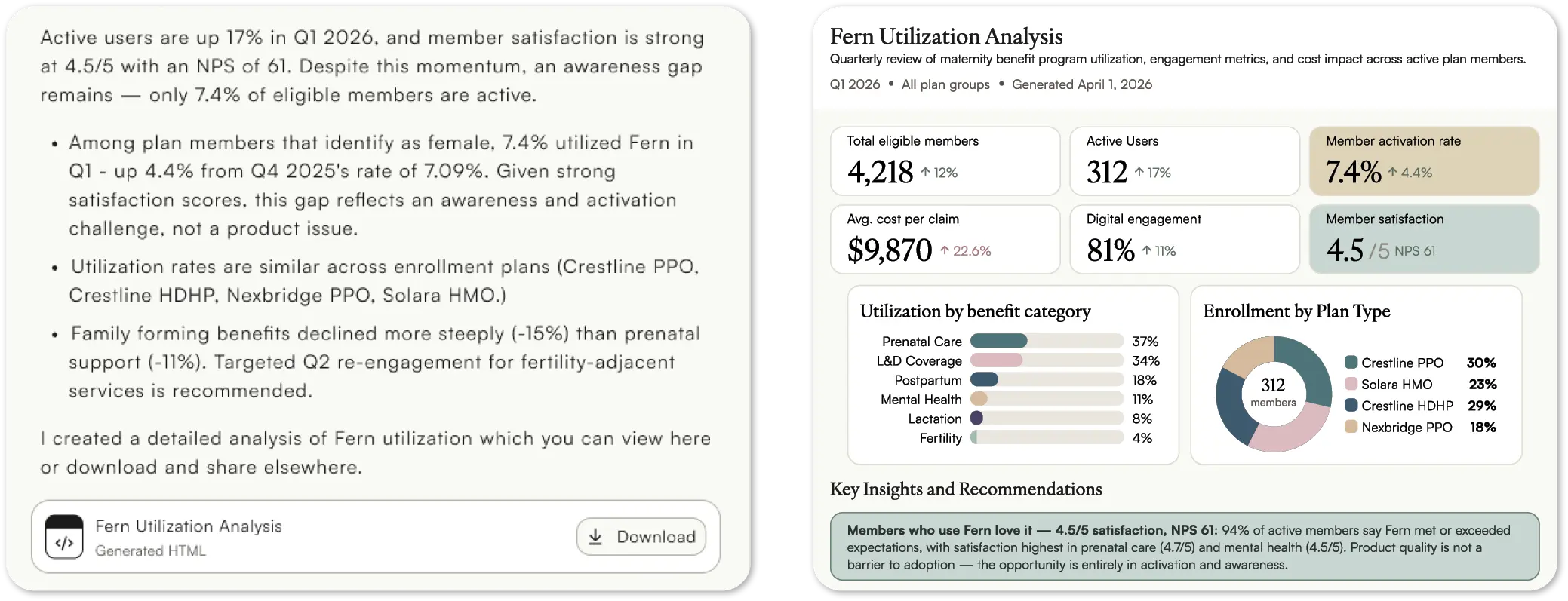
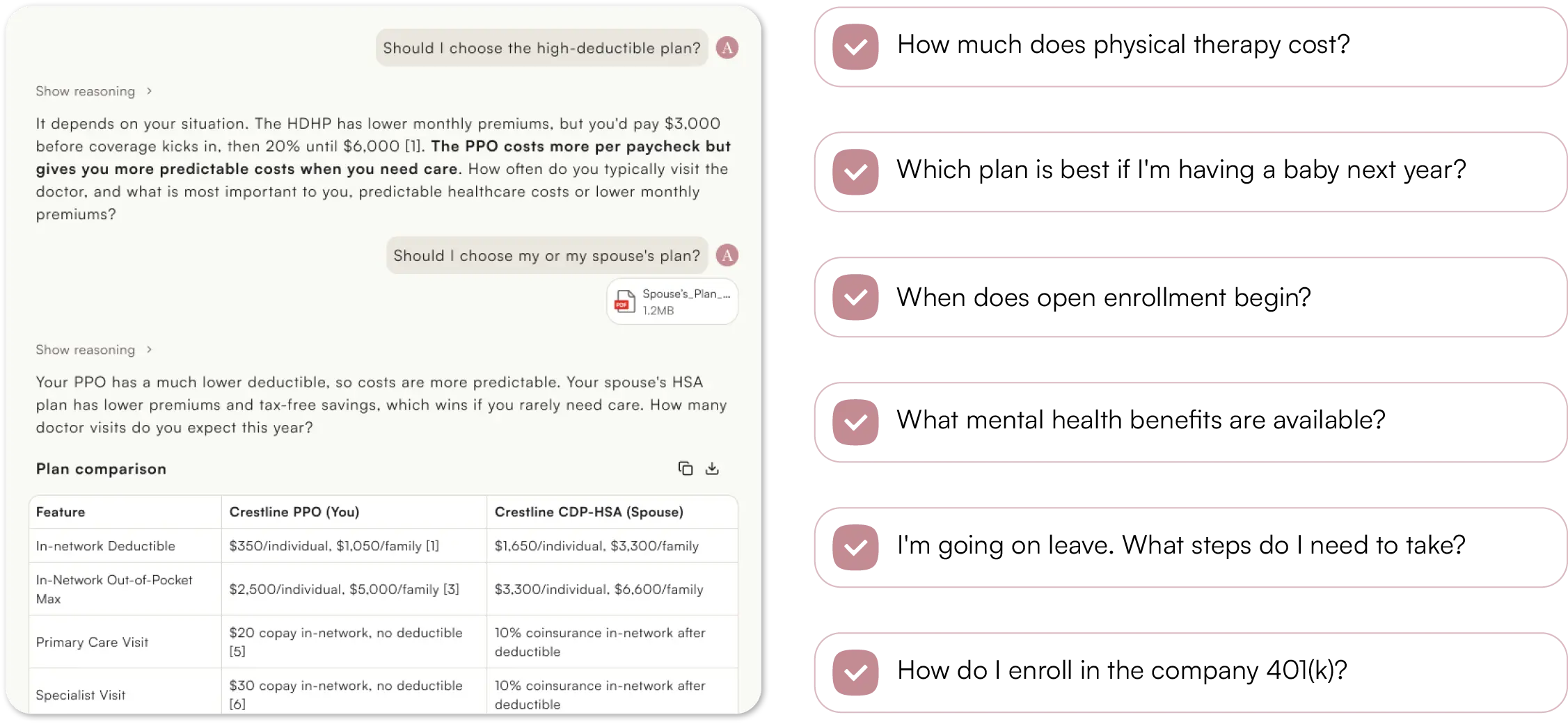
Carly, the agent for employees, gives Samsung’s workforce real-time, accurate answers to benefits questions, and prompts the right next step rather than answering only the literal question. It helps employees find and use benefits they did not even know they had, at the exact moments they need them most.
Screens are illustrative. Names and data shown are fictional to protect user privacy.
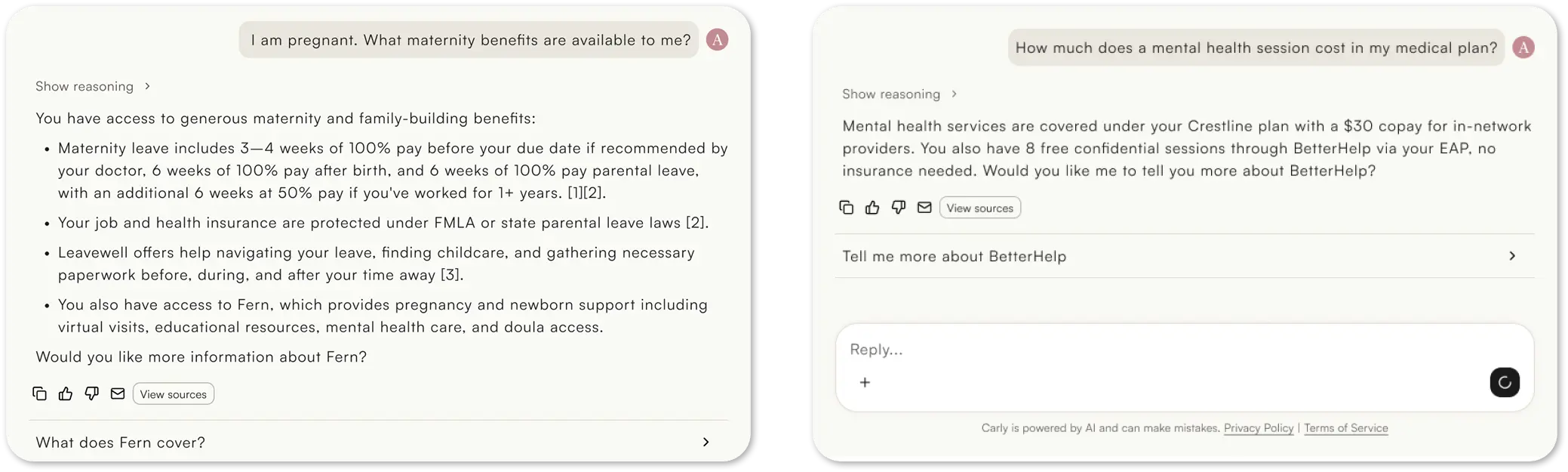
Together, the two agents give the entire company a complete picture of its own benefits, making the use cases below possible for the first time.
Results
What the team does with Ava
The use cases are virtually endless, from building reports to making the case for new programs, from developing customized communications to pressure-testing plan redesign decisions. These are just a few the team acted on in its first three months with Ava.
Use case 1: 66% increase in Lyra utilization
Lyra had traction, with strong engagement and a high share of employees in care relative to its book of business. But when the team dug into behavioral health using Ava, they were able to compare utilization across Lyra and the medical plan, the EAP and the carrier, two datasets that almost never get connected. They surfaced a gap they could not have seen before: a large share of dependents, especially children, were routing through the medical plan for behavioral health instead of starting with Lyra, where the team wants people to begin. The stakes are meaningful: care comes in on day one through Lyra, versus waits of two weeks or more through the medical plan.
The team used Ava to draft communications for that exact parent-and-dependent population, timed to Mental Health Awareness Month, and sent them that week. They also took the finding back to Lyra so it could sharpen its own outreach, and opened a conversation with the medical plan provider about surfacing Lyra first inside the portal. The result: from the first communications in May through the end of June, engagement with the dependent population improved and utilization increased 66%.
“It was a ten-minute chat with Ava that gave us key insights, so we could make targeted communications and address the exact gap instead of throwing spaghetti at the wall and sending out marketing materials that weren’t necessarily hitting.”
Cara Ayala, RD, CPT, CHC
Wellness and Benefits, Associate Manager, Samsung
Use case 2: Making the case for healthier food options
As dietitians, Sarah and Cara had wanted to address nutrition through the company café for years, and the project kept getting pushed aside. Working from the claims data, they pulled the disease states most influenced by nutrition, gave Ava their clinical guidance (whole-foods-first, plant-forward, lean proteins, healthy fats, and a simple green/yellow/red system employees could follow), and used Ava to produce an evidence-based meal program.
The café team now plans to use this framework during the current RFP process to ensure the new vendor is able to execute successfully. Additionally, the team will track the changes in their food program along with medical claims to see the impact. A project that had waited years came together in a single 2-hour planning session.
“Revamping our cafe and food options has been a passion project of ours, but it’s a project that gets pushed to the wayside year after year. But with Ava, it is now possible to move forward.”
Cara Ayala, RD, CPT, CHC
Wellness and Benefits, Associate Manager, Samsung
Use case 3: Building an airtight sabbatical program ROI proposal
Hortencia Alcazar, the Senior Benefits Analyst at Samsung Semiconductor, had built a sabbatical analysis by hand about two years ago. It took two to three weeks of research, formatting, and modeling. She rebuilt it this year with Ava, and it came together in a few hours. Ava pulled in turnover, mental health burnout claims, replacement cost, and tenure assumptions to model ROI at different vesting points, then packaged the work as an executive summary and slides ready for leadership. What stuck with Hortencia and the team was that when they tried to trick it with the data, it held its logic and double-checked them, reasoning exactly as they would have. The proposal is now slated for Samsung’s 2027 program.
“I’d classify Ava as a thought partner and an analyzer.”
Hortencia Alcazar
Senior Benefits Analyst, Samsung
Endless possibilities for AI-native teams
In addition to the use cases above, the team:
- Built a custom manager support guide for mental health crises in minutes by combining Samsung’s own mental health crisis-response document with materials from Lyra
- Assessed whether their preventative care solution was reducing cardiovascular disease and diabetes and found low engagement among comorbid members who need it most, driving targeted communications
- Explored redesigning the medical plan for next year, including options such as a migration from the OAP to an HDHP, which will inform future negotiations
- and more…
Results
What Carly does for employees
Before Carly, an employee who wrote to the shared service center could wait more than 48 hours for a reply, and often got an answer to only the exact question they had asked. Carly answers in real time, meeting the employee where they are with personalized guidance. 16% of questions come in after hours, when the benefits team isn’t available, meeting an employee at the exact moment they need support.
It also prompts the right next step. For example, when an employee asks about mental health coverage under the medical plan, Carly also points them to Lyra, the path the team wants people to take first. Every employee question becomes a chance to drive awareness of the benefit they should be using, at the moment they need it. In the last four months alone (February – May), Carly instantly and accurately answered over 1,500 employee questions, saving the benefits team approximately 930 hours.
Open enrollment, when question volume is highest, was a key point in the year to prove Carly’s efficacy and impact. According to Sarah Schutzberger, “It was the smoothest open enrollment we’ve ever had. The amount of time it saved our team was extraordinary.”
“Avante is transforming our employees’ experience, is giving our benefits team time back, and has yielded insights resulting in impactful interventions, which are having a positive impact on the health and wellbeing of our team.”

Kevin O’Connell
Senior Director, Total Rewards & HR Operations, Samsung
Screens are illustrative. Names and data shown are fictional to protect user privacy.
How the work itself changed
With Carly fielding the day-to-day employee questions, the team reclaimed the hours it once lost to repetitive inbox support and redirected them to strategy and program development.
The team spends that reclaimed time with Ava, now its first stop for any question, communication, or decision. They use Ava to answer real-time questions in a standing Friday meeting with leadership and bring it to events to pressure-test ideas on the spot.
Ava gives them more strategic insight, faster, and it’s backed by data they trust. In its first few months, the team reclaimed hundreds of hours using Ava to build leadership and employee-facing deliverables and run dozens of cross-source claims analyses that used to take weeks by hand, or days waiting on vendors. That level of visibility and ownership also changes what gets approved. Walking into leadership with the data and the reasoning behind a recommendation moves more initiatives forward, and gives the team the confidence to put program and plan redesign recommendations on the table.
“It’s easier to push things through leadership when you have the data and the why behind the strategy.”
Sarah Schutzberger
Benefits and HR Operations Sr Manager, Samsung
“I don’t know what I did before Ava.”
Cara Ayala, RD, CPT, CHC
Wellness and Benefits, Associate Manager, Samsung
Look ahead
For Samsung, these are the early innings. On the roadmap: bringing their own drug-utilization data to PBM negotiations; connecting LOA, short-term disability, Lyra, and medical claims to forecast and prevent leaves; and next year’s medical plan design.
Benefits clarity for employees and HR
Samsung Semiconductor runs a generous benefits program, including several point solutions, focused on emotional, social, financial, and physical health and wellness for their employees and dependents.
“If you don’t have AI on your benefits team, you’re already behind. Especially in our industry, our employees are so used to using AI in everything they do, from coding to drafting. It’s everywhere. If we don’t have it, how can we stay aligned with the technology and the experience they’re already used to?”